SWATGenXSWATGenX
Watershed ExplorerExample modelsCloud calibrationDocsAccess
Continental U.S. · NHDPlus HR

Watershed modeling for every river in the continental U.S.

Build with SWAT+. Couple groundwater with MODFLOW 6. Calibrate in the AWS cloud — streamflow, nutrients, PFAS, and groundwater. Explore results in the browser.

Built with:

  • USGS NWIS
  • NHDPlus HR
  • WBD
  • gSSURGO
  • NLCD/CDL
  • PRISM
  • NSRDB
  • SWAT+
  • QSWAT+
  • SWAT+ Editor
  • MODFLOW 6
  • Flopy
  • GDAL
  • SGX3D
  • AWS

SWATGenX in three minutes

Frames from platform runs — SWAT+ assembly, MODFLOW 6 coupling, USGS calibration, site-scale PFAS.

Flagship film · 3 min 20 s · real model frames · privacy-enhanced YouTube on play.

More films on the SWATGenX channel →

Capability tour

Eight pillars of SWATGenX

All eight ship in one watershed workflow and one portable SWAT+ project.

01 · National groundwater inventory

28.8 million well records — collected and harmonized.

State agency well logs, interval-by-interval — searchable, mappable, and ready for MODFLOW 6 setup.

Explore groundwater data
National groundwater modeling-readiness map
National modeling-readiness surface derived from depth-resolved groundwater well records
CONUS modeling-readiness from the well inventory.
Database specs
28,800,000
lithology depth intervals
7,900,000
mapped well records
46
CONUS states
856,000
model-ready (screen + yield)

02 · National PFAS data moat

Harmonized monitoring, soil profiles, and screened facilities — live counts load from the inventories.

Water, groundwater, soil, and tissue measurements from public agency records — joined with depth-resolved soil reports, potential-source screening, and PFAS litigation dockets for site context.

See the full PFAS data holding
Live inventory counts
94,100+
monitoring stations
1,212,680+
PFAS observations
30,972+
depth-resolved soil records
196,710+
screened potential sources
CONUS PFAS monitoring and soil coverage map
CONUS map of measured PFAS inventory coverage, with agency source counts by state
Monitoring stations, depth-resolved soil profiles, and screened facilities — counts from live APIs.

03 · HUC8 → HUC12 → HUC14

Model the reach you study, not the whole basin above it.

Cut at a gauge, a HUC12 outlet, or a single HUC14 catchment — and let the model above it supply the boundary.

See nested modeling
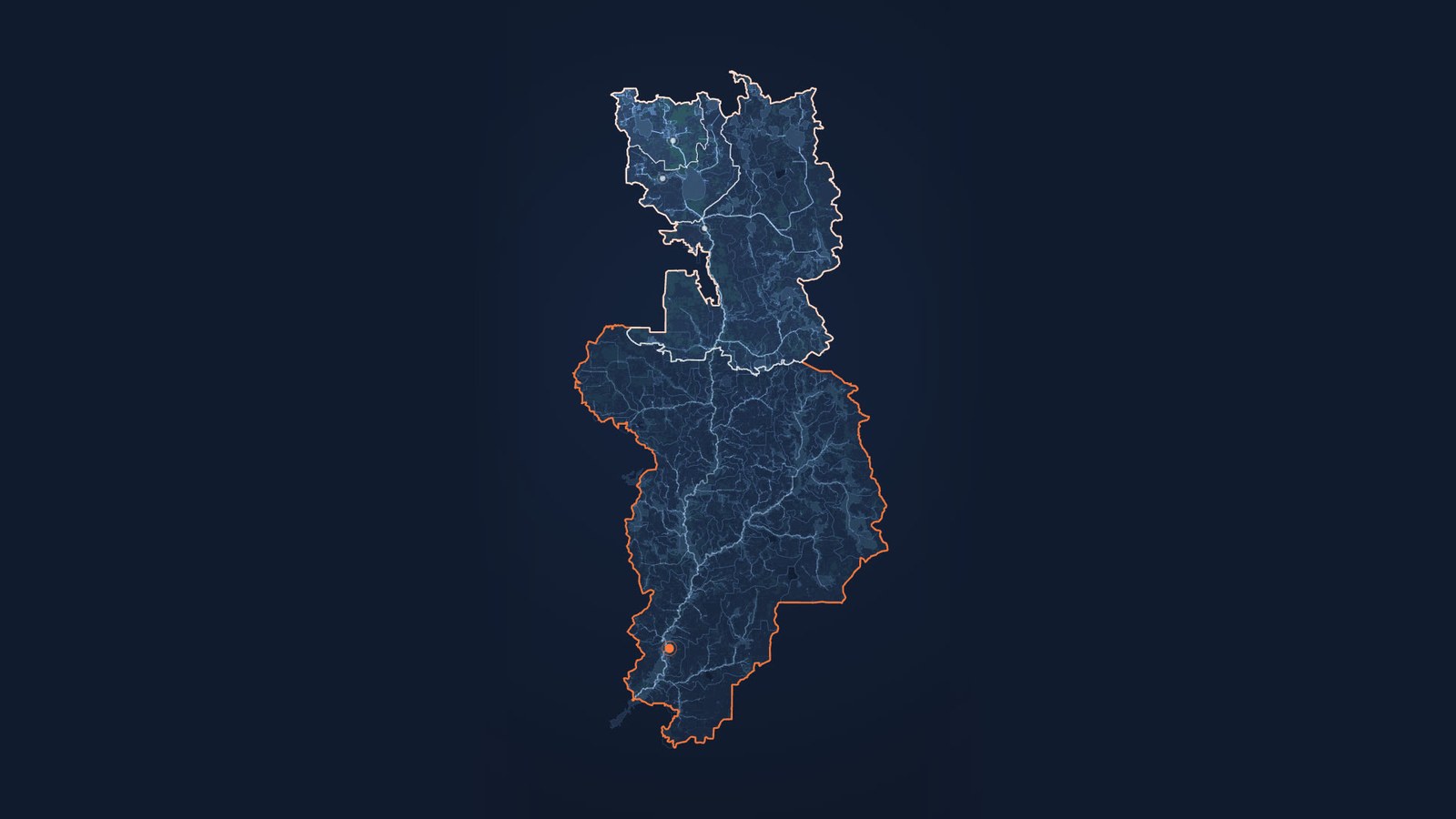
Peace River, FL — the same basin cut at successive gauges: 3,832 km² and 39 HUC12 units at Arcadia (USGS 02296750), 1,448 km² and 13 of those 39 at Bartow (USGS 02294650).
Platform scale
25,335
USGS streamgages indexed for model building
87,387
HUC12 watersheds in the Explorer catalog
10 m · 30 m · 250 m
3DEP DEM · NLCD/CDL land cover · gSSURGO soils
4 km · 2 km
PRISM climate · NSRDB solar

04 · SWAT+ / MODFLOW 6 coupling

Fully coupled SWAT+/MODFLOW 6 via BMI/XMI.

One model across land, vadose zone, and groundwater — no linking-file pipeline. Inspect long runs in 3D.

See coupled modeling
Tampa Bay tributaries — coupled SWAT+/MODFLOW 6, full-orbit from SGX3D.

Coupling specs

  • InterfaceMODFLOW 6 BMI/XMI — no linking-file pipeline
  • Mass balanceConserved both ways — one MODFLOW 6 budget
  • PathLand ↔ explicit vadose column (every cell) ↔ groundwater ↔ streams
  • CodesSWAT+ land/channel · MODFLOW 6 GWF + GWT
  • ConstituentsNative PFAS F&T in the coupled run

Live SGX3D on PFAS fate & transport · open viewer

05 · PFAS fate and transport

Two-way PFAS and water coupling in SWAT+/MODFLOW 6.

PFAS crosses the surface-water/groundwater interface in BOTH directions — soil leaching loads the aquifer, groundwater discharge returns it to the streams. Freundlich sorption, UZF/UZT vadose delay, MODFLOW 6 GWT. Wurtsmith AFB is the example.

See the PFAS science

Two-way coupling.
For water and for PFAS.

PFAS leached from the soil column loads the groundwater transport source term, and PFAS discharged with groundwater returns to the stream channels — both bound live through the MODFLOW 6 BMI/XMI interface, in the same daily loop as the water exchange. No WASP, no RT3D, no third-party water-quality model anywhere.


Mass balance preserved.
Across groundwater and surface water.

The obvious objection to any two-way exchange is that mass gets counted twice at the interface. It cannot here, because neither direction keeps its own ledger. Leaching is written into MODFLOW 6's own GWT source package, so the solver accounts for it in its mass budget; the return flux is read back as baseflow × node concentration — the same groundwater flow term MODFLOW 6 itself uses to remove that solute from the aquifer. One budget, both directions, nothing to drift.


Vadose zone simulated explicitly.
A column under every cell.

The usual shortcut is to represent the unsaturated zone as a lumped lag, or to skip it and let recharge arrive instantly. Neither happens here. Water and PFAS travel through an explicit unsaturated column beneath every active grid cell — MODFLOW 6's own UZF and UZT packages, kinematic-wave unsaturated flow with transport and retardation — before they ever reach the aquifer. At Wurtsmith that is 1,505 unsaturated columns, one per active cell. The breakthrough delay you see is computed physics, not a fitted lag.

Wurtsmith PFOS · ~250 m · 3 layers · 1971–2024 · SGX3D capture.

Example site — Wurtsmith AFB

  • CouplingTWO-WAY — water and PFAS, both directions
  • Mass balanceConserved — MODFLOW 6 budget terms, no side ledger
  • EngineCoupled SWAT+/MODFLOW 6 — native PFAS F&T
  • SorptionFreundlich soil sorption (Kf / n)
  • Soil → aquiferLeaching loads GWT source (M4b)
  • Aquifer → streamGW-discharged PFAS to channels (M4c)
  • Vadose zoneExplicit column under EVERY cell — UZF/UZT (1,505 at Wurtsmith)
  • ExampleWurtsmith AFB — PFOS 1971–2024 · ~250 m · 3 layers

Interactive run on PFAS fate & transport.

06 · Public MCP server

Ten MCP tools for Claude and Cursor.

Search models, query groundwater and PFAS inventories, preview builds — and with a key, order and download SWAT+ packages.

See how to connect
11 MCP tools

What the assistant can call

Claude · Cursor · other assistants
  • search_swat_modelsBrowse the example-model catalog (state, size, calibration status)Open with account
  • get_model_calibrationCalibration and held-out validation NSE / PBIAS for one modelOpen with account
  • query_groundwaterNearest wells and lithology from the 28.8M-interval national inventoryOpen with account
  • query_pfasNational PFAS monitoring inventory by state or analyteOpen with account
  • request_modelPreview what SWATGenX would build for a gauge or HUC12 outletOpen with account
  • get_engine_infoSWAT+ engine fork, compile guide (/compile-swat-plus), and toolchain pointersOpen with account
  • get_access_infoThe access ladder and your current tierOpen with account
  • order_modelOrder a real SWAT+ build (fair-use allocations apply)API key
  • get_order_statusTrack a build order to completionAPI key
  • list_my_modelsList your build ordersAPI key
  • download_modelMint a 24-hour pull link; your agent saves the ZIP locallyAPI key

Connect once. Catalog, inventories, previews — API key for order and download.

07 · Open parallel SWAT+ engine

Byte-identical parallel SWAT+ for HRUs and streams.

OpenMP wavefront on HRUs and channel routing. Certified byte-identical — 18 of 18 checks, 935,130 values each — ~7× on Peace River.

See engine benchmarks
Thread scaling — one simulated yearAWS c8a · 32 cores
0×2×4×6×ideal124816245.33×threads
One-year run: 143 s → 27 s. Self-relative speedup of the parallel binary; still climbing at 24 threads.

08 · Automated cloud calibration

Fully optimized MMPSO calibration on dedicated AWS.

Calibrate SWAT+ against USGS streamflow on per-job EC2 instances — parallel MMPSO, live dashboard convergence, AWS billed at cost.

See cloud calibration
SWATGenX calibration wizard Review and launch — model, gauges, windows, parameters, and compute
Calibration wizard — review gauges, windows, and compute before launch.

Calibration specs

  • AlgorithmParallel role-aware MMPSO (PSO swarm)
  • TargetUSGS streamflow — calibration + held-out validation
  • ComputeDedicated per-job AWS EC2 — spot / on-demand auto-selected
  • CostAWS billed at cost — estimate shown before launch

Watershed science, end to end

One platform — from national inventories through coupled models, cloud calibration, and a parallel engine.

Explore free. Connect Claude or Cursor over MCP. Create an account when you order a SWAT+ package.

Open Watershed ExplorerSign in

Need larger allocations, coupling, or calibration? See access levels.

Appropriate use

Flood and rainfall indicators on SWATGenX are for rapid triage and planning context, not a substitute for site-specific hydraulic studies, FEMA flood insurance studies, or official emergency warnings. For methodology and citations see Data & methodology. Account rules and data practices are in the Terms of Use and Privacy Policy.